If there is one exciting occurence to have finally risen from the ashes of this year, it would be the happy news that the new Netherby Farm dairy is finally up and running. After breaking ground last October, with months of inactivity due to Covid, they finally went live in the new dairy a month ago, Dad being given the honours of hooking up the first cow to the machine.
I’m led to believe that the roof hasn’t quite been christened yet- should I be sending some Champagne guys?-, but my litle bro’ and my dad hosted an open day this week for all the locals, and honestly, I can only begin to understand the momentousness of this occasion. In a text message I received from Dad in the morning, he reminisced about the days when us little Carr kids would spend hours writing on scraps of paper in his poky office that doubled up as ‘chemist’ and tool shed. In his message, Dad spoke about how he found my nieces and nephew drawing in the boardroom- things may change, but others stay the same.
Receiving all this news on the end of a message is joyous and exciting, and also sad because we can’t be part of it. I want to write about it so much, but it’s not my story to tell, I can only share what I’ve read, and also reminisce about my dairy days as a kid.
Growing up as a dairy farmers daughter is part of who I am. [No, Siblings and Father, I still don’t drink milk, but I’m all over cheese like a rash, and in this age of almond milk, oat milk, soy milk, whatever-you-can-eke-out-of-a-nut-or-cereal milk, I’m still a staunch Real Dairy supporter.]
I spent the first 18 years of my life living in the house that Dad grew up in, on the piece of land developed by my grandfather, Errol Carr who had worked it under the guidance of Ned and Clara Carr. Netherby house used to be a little tin structure. I’m not sure super-wood was a thing at the time, but when I was a kid, there was a pressed-wood barrier between the rooms and the corrugated exterior. Errol and Ruth were hard working farmers and ploughed every bit of their income back into the dairy. In 1955 when they decided to begin supplying milk to sell, the realised they needed to change their dairy set up: up until then their dairy had an earth floor, milking was done by hand and moved around in milk cans on the back of a wagon drawn by oxen. At this point, they cemented the dairy floor and converted to a bucket milking machine system. The bucket milking machine was the first pump vacuum system. Milk would be pumped into milk cans, and then these would be carried off by hand to the ‘cooler’.
When Dad was finally given the reins to the family dairy farm the year he married the sum total of cows he milked was 60. According to Dad, when he took over in 1975, the health inspectors condemned that 1955 building and my Dad to build a brand new dairy. He took the opportunity to install a more up-to-date mechanical set up. This is the first dairy I have memory of. This dairy was large enough to milk 8 cows before switching the pump over to the ‘other side’ while another 8 cows, freshly milked, could walk out, the line queued with 8 more cows, ready for the machines to be swung back over. Between each cow being milked, the milk would be pushed to the ‘bulk tank’, the glass bottles and pipes flushed out with water.
As dairy farm children, we were compelled to get out of bed and do chores: collect the hen eggs, feed the calves with fresh milk, ‘help’ with the milking and when we were able to write, were able to assist recording data in record books of the amount of milk each cow produced. Dad, whose handwriting was eligible would be only too happy to allow me to take over scribe duties. The milk parlour was inevitably a pretty shitty (and I mean that quite figuratively) space: Between 2 ‘races’ (a corridor queue kind of space) on the left and right hand side of a pit that was a metre lower, was where the dairymen would work from; the cow udders would be at eye level for this tall 7 year old girl. I had no objection (I don’t think) to being in the pit and ‘helping’ with the milking, alongside the dairy staff. After I had performed the required squirt of milk into a test cup to determine if mastitis was present and had ‘dipped’ the teats in a disinfectant, I would be handed the teat cup cluster, and as the vacuum pump would whirr to life I would place the teat cups below the cows teats and slip it on as a vacuum tugged at the leathery teats dangling below the soft udders. 4 teat cups later, the gentle whooshing of milk would pull through the pipes and be pressed into the glass bottle. If you could block out the sound of the engines making the machines work, the sound of the milk whoosing in the pipes, the pressure of sucking and pushing and spraying was peaceful in a way. Eventually the speed at which the milk arrived in the bottle would subside, so with my hand back on the clusters, the pump would be stopped, and gently I would remove the teat cups from the teats and hand it back to whichever dairy staff had been tasked to help this young missus with her chores.
As I got older, I used to long for the days when Dad would let me write in the milk recording books: This would entail 2 hours of concentrating as all the cows would be milked, and their names called out followed by an amount of how much milk each had produced. Each of Dads 100, 150, 200 cows were given a name. Each month, Mom would lovingly (?) transcribe the alphabetised, updated list so that a weekly account of how much milk was produced. Naming those cows was a labour of love in itself. The cardboard records were kept dutifully in Dads office/chemist/tool shed. The records were kept much like a doctor keeps records of patients: name, date of birth, dam and sire, dates of insemination (oh that’s a tale for another day) and offspring.
My absolutely most favourite job happened quarterly: the occasion when each cows’ milk was tested (for what, I can’t remember). It entailed crates of tiny glass bottles, each with a substance coating the base- possibly a control or preservative, and a label on the cap. It would involve the milkers bringing over a sample from each cow as they got milked, I would be able to syringe up another sample and squirt it into the allocated sample bottle. This was a much sought after job, and due to error of being a child, I wonder how many samples were spoiled, or records made incorrectly.
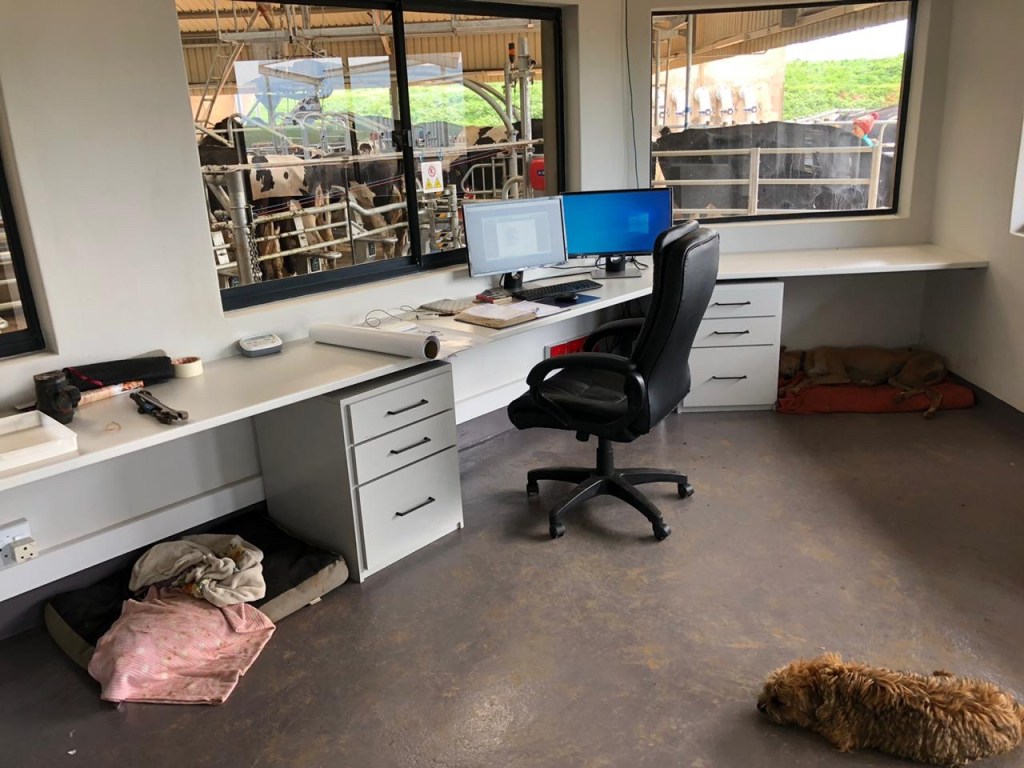
Eventually the 8-swing point milk bottle system became too cumbersome for the increasing dairy herd, and Dad invested in a new dairy. The plan for the new dairy included 20 milk points and a post feeder: this meant the cows would file through to a shed where they received an additional serving of meal following their milking. Dads dark windowless little office was converted to a full-time chemist and tool shed, and a new office was built overlooking the dairy pit through a set of windows. Those windows sadly never stayed clean: between the inevitable spray of cow fecal matter and fly poop, one would peer through to locate the man of the hour should you seek him and he wasn’t in his office.
At some point, Dad needed to install a new bulk tank. A bulk tank is a massive stainless steel milk can. It has a rotating arm to stir the milk to keep it fresh, plus coolers to be able to maintain a lower temperature in an effort to preserve the shelf life. Just prior to installing the new tank, I had grown tall enough to open the hatch at the top and reach into the tank to collect milk for the house. There was also a dip stick that I could pull out to read how many litres were in the tank. Those were the days when, if we were home in the morning when the lorry would arrive to collect the milk, we would have to read off the dipstick measure and write down how many litres of milk were being collected. (At the end of the month we used to take immense pleasure in tallying up the figures, and comparing them to the previous month).
Those were also the days when there were only 2 creameries in Natal: Creamline and NCD, and trying to get any sort of ethical mutually beneficial sales relationship from either was impossible. They eventually decided that the business of collecting milk in Boston was not worth their effort so a small side business was built up in the 90’s: Boston Dairies. Dad and 7 other competitive farmers invested money into a milk truck. They were responsible for delivering their milk to Creamline in Durban and somehow earned a small profit off the business.
The new tank was enormous. The tank room walls had to be broken down to fit it in, and fresh walls built up afterwards. It was so big that Dad even had to climb a ladder to open the hatch to retrieve the dip-stick. One day his Swiss army knife tumbled out of his breast pocket and dropped into a vat of swirling cold milk. He admits that his very first mobile phone, a dinosaur Nokia, was also swallowed up by that tank. (I’m pretty sure that phone still worked properly once it was retrieved and dried out).
Times move on. Sustaining a large dairy needs ongoing growth and changes. Dad, who had been milking his own fathers cows from the time he finished school at 16 started getting tired of the 4am alarm, the constant need to expand the size of the dairy, to feed the monster that is essentially how South African farmers need to exist. Small scale niche farming just won’t get you very far there. Increased grazing, a greater demand to ensure bacteria free safe milk made somewhat harder by the bigger herds of cows, my little brother stepped into some pretty scary times when he moved his family onto the farm in 2014.
But Gra has never failed at anything, and he put his head down and has tackled some huge challenges. I haven’t been around to write about those occasions, but I know for sure he has done some remarkable work in taking his dairy properly into the 21st century.
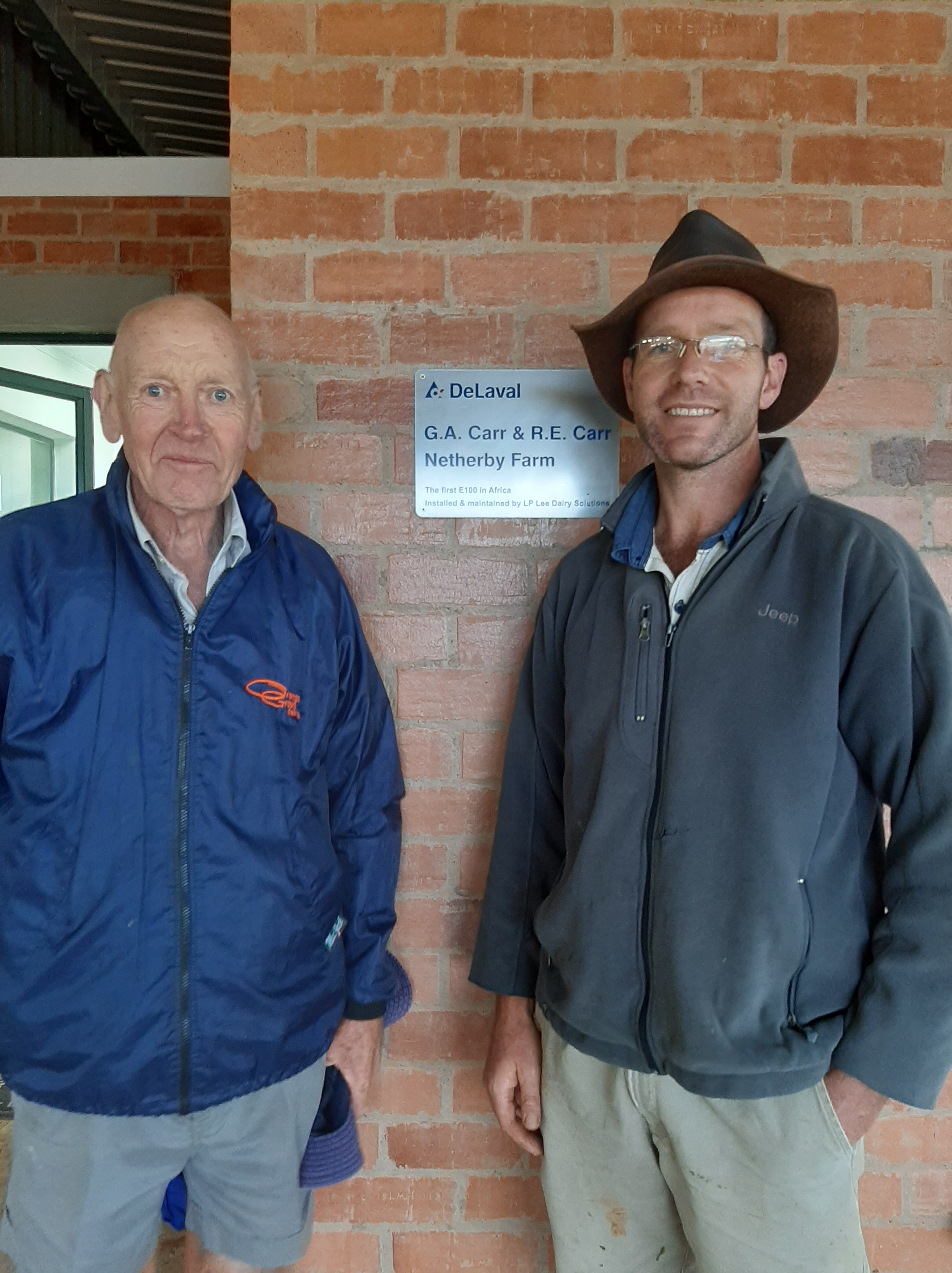
I saw a photo yesterday taken at the dairys’ open day. It was of my dad and brother standing in front of a plaque that had been hung by the dairy equipment supplier. DeLaval. DeLaval have been around for decades, and going back the 1975 when Dad installed his first dairy, the equipment was DeLaval. Nothing has changed and DeLaval are still recognised for the equipment they supply to the dairy industry. In the photo below zoom in to read that plaque: Graham has installed the very first ‘E100’ dairy in Africa. That’s pretty awesome. Honestly, without actually seeing it, I couldn’t begin to describe how it looks. But it’s rotating, mostly set up that all data is electronically read, and it’s clean. The days of manually scrubbing the floor with pipes and brooms is a thing of the past. A clean dairy means less bacteria making the milk bad.
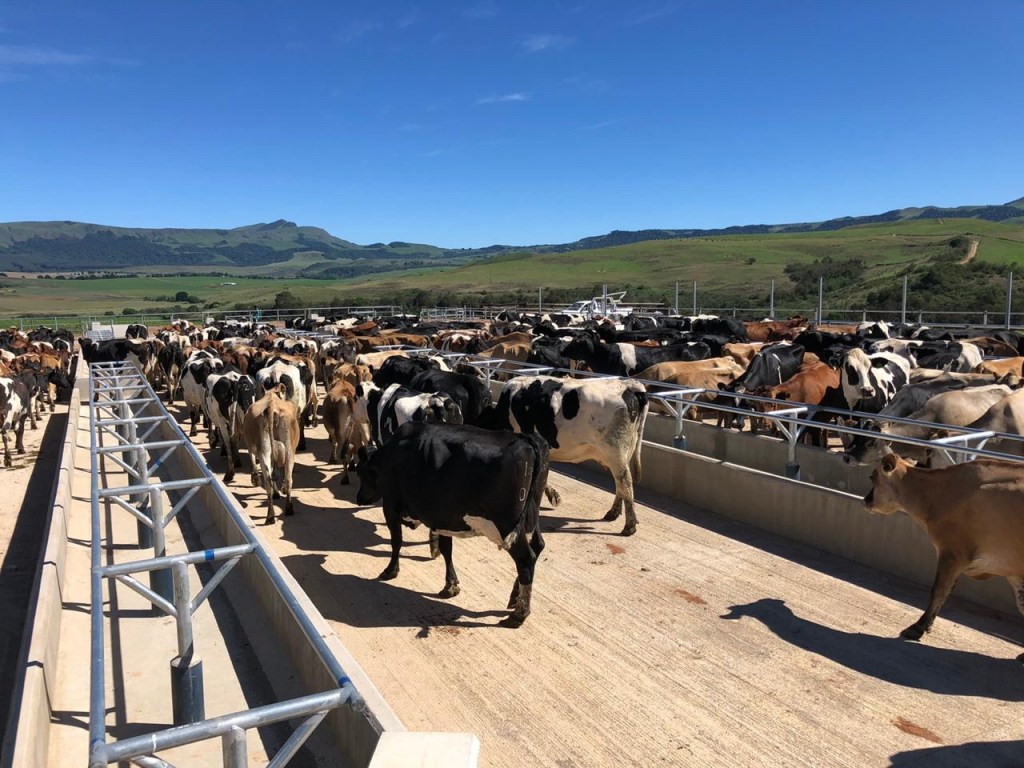
Naturally everyone wants clean milk, and with pasteurisation, your milk will be devoid of nasty little gremlins. But financially, milk free from high bacteria count means a better quality, and in turn, a better price, therefore, the cost of a sparkling new clean dairy begins to pay itself off. But bacteria levels aside, Graham knows what it takes to run a dairy having been a vet in other parts of KZN that milk in excess of 500 cows. Having taken over more than 6 years ago, his dairy herd has doubled, which has meant the time milking cows has doubled. That’s a lot of labour expenses to pay for, that’s an exhausting amount of time spent in a freezing- or boiling- cement warehouse with a tin roof. The new dairy has three times the holding capacity for milking, and feeding takes place while the are milked.
Dad’s job was to train the cows to walk onto the rotating platform. I found this an appropriate job, as I remember when he had upgraded the dairy from an 8-point swing to the 20 point version, he had built steps for the cows to walk down once they were done. Apparently cows don’t naturally know how to walk down steps. Dad may have to correct me in this memory but I remember him telling me how he had someone design the steps according to the stride of a cow, and how he had had to ‘teach’ the cows to walk down them. Exactly what it entails – you’ll have to ask him.
More than 65 years of milking cows on Netherby Farm, and what a story could be told. I wish I could do it better. From 60 cows to 600 right now, (projections reaching 800 in the next year), from hand milking and metal milk cans to customised rotating parlours, Graham and Dad, you have done one amazing job of continuing with a family heritage.

 Pinot, Bretzels, and Cathedrals
Thanks for the trip down memory lane! Congrats on the snazzy new parlour! X