From the moment in February last year when I realised that something was wrong with Anton, until January, 11 months later as I sat by his bedside watching him die, I spent 12 months writing around the topic of his GBM. 12 months I skirted around my fear, not wanting to say the words [my husband has brain cancer] aloud, while still trying to write with clarity to reveal a journey, and being respectful of all the players: I needed to maintain hope for everyone, most especially Anton who was living it, and didn’t need my bad vibes.
For what and to what end? To find myself going for a solo run a few weeks ago, in the forest on an icy cold winter’s morning, collapsing in a heap on the forest floor, sobbing to the still hibernating birds. Sobbing for his absence. Sobbing for the fear of going at it alone. Sobbing for the part of me that has literally disappeared.

Grief is all that’s left. Or that’s what it feels like 6 days out of 7. I know that being able to write will go a long way to pouring those emotions out, and maybe in time, I’ll get closure. Or a book deal. (Does anyone know a publisher who might be interested in my missives?)
12 months ago this week, Anton was fresh out of surgery after an MRI scan had picked up a lesion in February. Up to that point I had refused to acknowledge that it was life threatening. I had downplayed it to my Dad, my sister, and it was my brother who told me to acknowledge the reality. His words “you should not feel kak for panicking. FFS, your husband has a brain tumour” hit me hard.
51 weeks ago we received the diagnosis. The tumour was a glioblastoma.
85% of people who are diagnosed with those tumours don’t recover. They’re grade 4 cancer. I wish I could explain the manner in which neurosurgeon who gave us the diagnosis did so, but perhaps my memory is blurred. His office on the 8th floor of the university hospital was cold and governmental- it had an older computer at the desk (which couldn’t allow us to see the size of the tumour from the MRI scans when we asked). He was young, and while his English was a million times better than my French, I felt that he lacked an element of empathy for the diagnosis. I suspect this is mostly due to the language barrier.
Aside from the fact that they hadn’t been able to remove the entire tumour he went on to say that “The diagnosis is bad. The tumour is a glioblastoma. They’re the worst kind to be found in the brain”. He then went on to say that the cells were mutated so there was hope that a course of radiation and chemotherapy would eradicate traces of the mutated cells that gave rise to the glial cells. In hindsight, it now feels veiled and misconstrued.
He informed us that we would need to decide if Anton was to go straight into oncology as soon as possible, or enter a re-education centre to help him learn how to walk again. Following the surgery, most likely as a result of swelling on his brain, Anton had been left with a level of paralysis, and was unable to walk. The neurosurgeon had explained it was likely to be reversed, and through therapy, he would be able to walk again.
Naturally we went straight for the oncology route, because when faced with a cancer diagnosis, that’s where you go.
We left his office visibly shaken. We took Anton downstairs into the picnic area in front of the hospital and sat at a table with coffee. I picked up my phone and googled the glioblastoma diagnosis. 85% of the patients survive 12-18 months. It’s only 10% who survive for more than 5 years.
Naturally we chose to fight it. Neither Anton nor I accepted the fact that we would not see our 20 wedding anniversary. (We won’t). At no point did Anton consider not going back to work. At every opportunity we assumed that he would get through the 6 weeks of radiation, the next 6 months of chemotherapy and by then he would be able to return to work. That is where we spent Every. Single. Day of his treatment.

The oncology journey was different to how I assume many other cancer patients endure their therapy.
My Mom had had chemo IV infusions for her Hodgekins Disease in 1999 followed by radiation therapy afterwards. 15 years later, when diagnosed with cancer in her uterus, she had started on IV chemotherapy for that, but she gave that up after 3 months (but that’s a story for another day.)
Treatment for Anton’s glioblastomas involved radiation treatment and the simultaneous chemotherapy was taken in an oral format. The side effects were quite different in that the nausea and vomiting and hair loss were less common. In Anton’s case, he had a protocol of anti-nausea medication anyway, and the radiation caused hair loss in one patch. Given he’s shaved his hair anyway for years, the absence of hair wasn’t a big deal.
Going back to sitting at the picnic tables outside in the sun on that sunny spring day last March, ashen with shock and fear, Anton said that he wanted to go back to South Africa to die. It was an initial shock response: he wasn’t about to collapse on the spot, and I have to admit, I was extremely annoyed at him. Our lives remain here in France, not to mention a real medical system to cover all our medical expenses. Gratefully he accepted that, and his next response was that we would fight this. We would “fight this” with every fibre of our being.
I’ve never been comfortable with the notion of fighting a cancer. The doctors fight it. Medicine fights it. And in turn our bodies turn up and go through excruciating pain. As a person on the side, I didn’t know how I could possibly fight it.
In hindsight, I still feel like I wasn’t an active participant in the fight, because my heart and soul- that other part of me, is now dead.
But.
But I showed up.
It took 5 seconds to know I was happy to give up work. I took on the radiation schedule, spending half days away from home waiting for ambulances and appointments. I made smoothies to be eaten following a fasting. I made food to suit his eating habits. I heard what he said about going to spend the summer with family in South Africa.
And then I continued to pretend, like he did, that he wasn’t dying. I forgot that glioblastoma patients don’t get to live for more than 12 months.
When I reflect on the last year of our life, the steps we’ve taken to that point when I started out for a run in the forest and ended up having an anxiety attack, I wonder what I could have done differently. I had done the research: glial cells that have mutated from astrocytes are THE most aggressive form of cancer. Those cells grow at an alarming pace and from what I’ve read and heard, a person can go from being apparently healthy to having life-altering symptoms within weeks.
Weeks. It’s a very raw, very real statistic to accept.
From the moment you see the symptoms, it’s almost as if it’s too late. Nowadays I scroll through photos on my phone, and my heart seizes up in dismay as I see how Anton’s demeanour changed over the months. The week he started radiation he stood upright and smiled at my camera lens. He was ready to fight. The week after the radiation finished, 6 weeks later, I could see he was strong. We celebrated the end of radiation. If I knew then what I’m going through now, I would have celebrated a small remission.
Cancer patients always talk about remission. That period when they get a green light to live without fear of the return. Anton never got to strike a brass bell to say Fuck You Cancer.
Continuing to scroll through my photos, I see his face while we were in South Africa. He was stooped over the cane. His eyes had become hooded and had lost their light. They no longer crinkled when he laughed. He no longer laughed. I don’t think he has laughed since that post-radiation party we had in June. When we returned to France after our summer, I feel that Anton fell into a state of depression. While chemotherapy didn’t render the vomiting and nausea that is common, his body would feel the tiredness that is associated with toxic poison. He started to retreat more than ever, using the tiredness as an excuse. I was selfishly sad when he didn’t do anything for my birthday in October (and instead it was Alex and Beth who stepped up). I feel like the months from September to December became a literal hinterland; an area that was invisible and unknown.
After all, why did Anton start in on the vomiting – a symptom of glioblastomas – when he was being treated with chemotherapy? How was it possible that there was a growth while he was taking in those poisonous chemicals that maybe altered his personality? The reality never properly landed in my heart. Those weeks we went through from his birthday in early November, (the last social trip he had to his office where we took a carrot cake as was the norm,) to being told we should bring forward the date of the MRI is a blur of very explicit memories. A juxtaposition if anything.
My messages remind me I had started on my driving lessons, that the headaches had started, that I needed to cancel his kinetherapy session. There are photos of when he was Père Noel for the last time for the office Christmas party, and that social weekend when some old friends came to visit from England. I’m certain that trip by the Pages is bittersweet: having only heard about Antons cancer a month before. They ended up being the last people to socialise with him at our home.
And then, the weekend before that heartbreaking MRI was the last occasion Anton and I were intimate, and I guess, with brutal honestly, I knew then that something was definitely wrong. Perhaps in memoirs I write later I’ll divulge my deeper reflections, but I shouldn’t divulge bedroom secrets now.
The day after was the beginning of the end. The ambulance picked us up at 7am. By now they knew to bring the stretcher up to our apartment as Anton wasn’t fit to walk the distance to the road any more. We arrived at the imaging centre before most staff had started, and I sat next to him on his bed removing his watch, his chain and cross, and his wedding ring. He never put the ring or chain and cross back on. We were quiet, not prepared to know what was really happening. I think we knew anyway.
2 hours later, we met our oncologist. He sat in front of his computer, opened the image that had been sent to him, and shook his head. The news was not good.
And yet, despite that, he said we could still fight it. Why? Because Anton was ‘young’ and fit.
How was he so wrong? Why was he not brutally honest and just admit that there wasn’t anything they could do? Why get our hopes up thinking we could carry on fighting? He had proposed a new course of treatment. THAT treatment had a 42 day cycle. FFS. If he thought to propose that treatment for 42 days, I assumed Anton would have life beyond that.
Naturally we chose to fight. We booked our dates for the week after to have ports put in, we booked the first session of the new treatment and we went home.
That evening I went out to a friend’s house for a Christmas dinner. Not willing to stop living, I did still feel guilt at being away from my family that night, that night when I should have been present to acknowledge what was going on. I had left a meal ready for them, but later when I phoned Alex to ask if all was okay at home, she admitted that their evening had been fraught. Fraught with Anton being angry when dinner wasn’t served promptly. Fraught with his anger when he couldn’t get to the toilet on time and had had an accident on the floor. I took that call in Pauline’s kitchen, and when I heard what Alex had said, I sank to my knees. I cried quietly into the phone, the guilt I had at leaving them alone like that suddenly flared to the surface.
The next day Anton wasn’t able to get out of bed, and that began the last chapter. Being upright caused nausea and vomiting, and that included sitting up to eat or drink. Over the next 36 hours he became dehydrated and it was truly frightening to see how he would only lie in bed with earphones on listening to an audible book I had bought. I had set up a bucket next to our bed for him as he couldn’t stand up to go to the toilet, while praying at every single moment that whatever THIS was, was reversible.
You know by now that there was no reversion, that Anton’s health continued to suffer. At some point once he was hospitalised, I took to WhatsApp updates, the number of people in that group eventually growing to more than 80 people. My Dad was able to rush to be with us, and it was as hard on him as it was on us, him having gone through a similar journey with my Mom 10 years ago. He knew before I did that it was the end.
The last 5 weeks were devastating. I assume you’ve read my January essay where I wrote of the effects of meningitis and how Anton seemed to fade away before my eyes. I shared that essay 3 days before he passed, not having a clue as to how much longer he would hold on.
In 2015 we flew out to South Africa to be at my Moms bedside in her last days. We knew it was the end, but couldn’t stay forever- we had to return to our French life. The day I left, my bags packed, a friend taking me to the airport, I spent time with her saying goodbye. I knew I wasn’t going to see her again. I told her I loved her, that I would be okay without her, and that she must rest. 48 hours later, our luggage unpacked and laundry washed, I recorded a video to send to her. Like Anton she wasn’t reading her messages by then, but I hoped Dad would show her the video. She never did see it: around that time, she passed away. She was ready.
I think my Dad saw how Anton was holding on for us. He’d spent 4 weeks with me, and he too needed to return to life back home so the day of his flight, he came to say goodbye to Anton.
That evening, a friend close to Anton came in to see him as the evening drew in. I’d spent 6 hours with him, as usual. As usual, I had agonised over spending the night, knowing that I probably never would: my girls needed me at home. I needed to be able to sleep in my bed. Our friend asked if he could spend some time alone with Anton. We left him on his own for a short while, and then I went back to say my goodbyes.
“I love my angel. We’ll see you tomorrow. And if we don’t, that’s also okay”.
Our friend mentioned a few weeks later that during his moment with Anton he’d prayed over him, and said it was okay to leave, that we’d all said our goodbyes and that it was time to go.
Sunday morning, January 19th, I woke early: sleep hadn’t been my friend for weeks already. I stood up and started preparing a curry for dinner. At 7, I made coffee (for me) and hot chocolate for the girls, we sat in bed planning our day: breakfast. Dog walk. Laundry. What time would we head to the hospital? Who was going to be with us that afternoon? At 7:50 Alex got into the shower. My phone rang. The name of the hospital flashed on my screen.
No. My heart skipped a beat-I couldn’t answer it. Beth took the phone from me. She’s always protected my heart. They asked to speak to me, she said they could speak to her. They hung up and immediately called back. I couldn’t avoid the inevitable.
An hour later, we sat at his bedside for the last time. The nurses had prepared his room for us. The table which Beth had worked was now adorned with art from the little maatjies and the only ever floral arrangement that was brought to his room (less than 24 hours before the end). They had also packed away what few items we’d left in his cupboards (I was grateful we had already taken home all his clothing). They had changed the bed linen. Changed his gown. His body lay flat, his arms above the sheets. This time there were no tubes to navigate. No whirring morphine dispenser. No noisy oxygen pump. He was still, and I reached out to touch his hand, half expecting it to be ice cold already.
It wasn’t.

I’ve never in my life seen a lifeless body. I didn’t know what to say or do. It was surreal, and I was torn between wanting to sob uncontrollably, lie beside him and beg him to breathe, to come back to me because I couldn’t go on without him: all very raw and inappropriate actions.
2 friends were able to be with us. I’m not sure sharing that moment was fair on them, but I will be forever grateful to them for being with us.
It’s almost 2 months since he passed. That date coincides with the day we received the actual GBM 12 months before. Even though I know now having read a medical report, they suspected the glioblastoma already after the PET scan on February 28. And didn’t tell us.
Less than 12 months is what we got. It’s not fair. It feels like we drew the short straw, that every day since February 21st 2024 has been fraught with challenges. As you can imagine, I am merely putting one foot in front of the other. I grieve deeply. I am steeped in anxiety for one thing or another all the time. I miss my life companion more than I ever thought I would. I feel guilty if I laugh. I don’t really want to get out of bed, but I know I have to make an effort.
I’ve rambled on for too long, but there is still so much I’ve not written. Anton never did walk properly ever again. We never got to eat at that fancy restaurant that I’d had my eye on and where we received a voucher to go from his team at work. He never properly wore the cowboy boots he’d coveted for 4 years and bought on a previous trip to SA. He never ended up using the very warm winter coat he’d bought for his America trip last January. He wasn’t able to put together a Lego car at any point after the surgery and I don’t think he managed to ever fix a Rubik’s Cube since the diagnosis. And if you knew him, you would know just how easily they came normally.
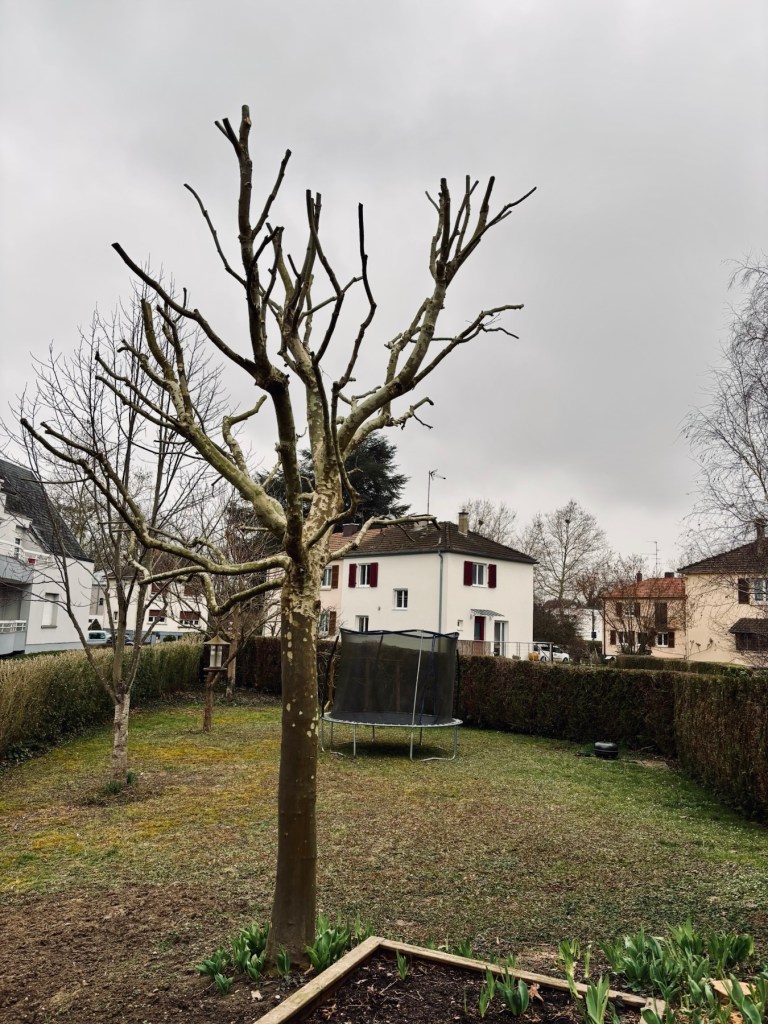
Last month we removed some trees from our garden. There were 2 poplars living side by side that had become a net of branches. To free up the light in our garden, one of those poplars was cut down and it feels little bit like my marriage does now. The remaining tree stands tall, and upright, but the absence of her partner is visible. I see myself in this tree left standing, and I know, I still have a long journey ahead of me.

 Pinot, Bretzels, and Cathedrals
Beautifully written and so real. I have no words. Sterkte. 💔❤️🙏